Field note
AI Took My Job in Six Months. Here's What Replaced It.
I fought AI, lost, then went all in. A year later, the work that matters most isn't the code. It's seeing the whole system.

The world changed, and I watched it happen to my own job.
For years, a big part of what Y-Verge did was build work: stores, integrations, the code that holds a commerce business together. Doing that work well was our edge. Then AI learned to write code.
At first, I fought it
My first reaction wasn't curiosity. It was defence. I tried the tools, found the mistakes, and told myself the output wasn't good enough to matter.
I was right, for about six months.
Then it was good. Not perfect, but good enough that work I had spent years getting fast at could be done in a fraction of the time. My job, the way I had defined it, was gone. That's how fast it happened. There was no slow decline, just a gap that closed in half a year.
So I learned it properly
Once I stopped fighting, I started studying. Not prompt tricks, but how these systems actually behave: where they're strong and where they fall over.
Three things surprised me:
- AI is a good teacher. I learned faster with it than I'd learned anything in years. Ask it to explain, push back, ask it why.
- AI is a team player. It doesn't get tired on the fifth revision or defensive about feedback.
- AI is smart and fast. Not in a hype way. In a "this would have taken a week" way.
One year in: all in, and what I found
After a year of leaning fully into AI-driven work, one thing became clear. AI keeps getting better, fast. But it doesn't have the whole picture.
It can write the function. It can't tell you whether the function should exist. It doesn't know that the warehouse team changed their process last quarter, that the client's real problem is cash flow rather than conversion, or that fixing this bottleneck will just move it somewhere else.
That leads to an uncomfortable conclusion for anyone who built a business on technical skill:
When code is no longer the moat, how you manage and deploy it is what matters most.
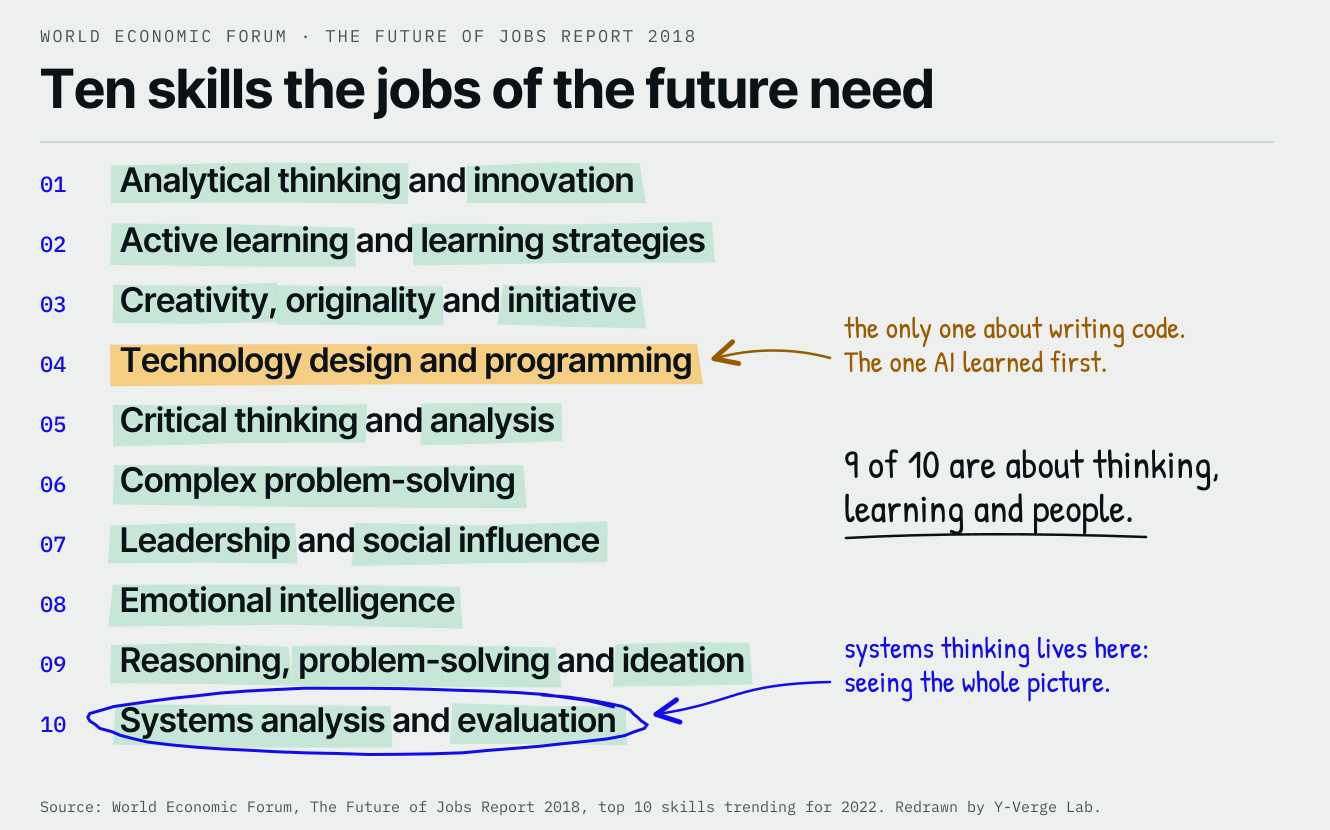
The World Economic Forum's list of the skills the jobs of the future need points the same way: only one of the ten is about writing code, and it is the one AI learned first. The last one on the list is the one this whole post is about.
Tactics vs. strategy
Most AI conversations I see are about tactics: which tool, which prompt, which model. Those matter, but they're now the easy part, and they change every month.

What doesn't change is the need to see everything from a high level: how work flows, where decisions get made, what feeds back into what. That's why I believe systems thinking and a first-principles approach are the missing ingredient in most AI adoption. They're how you decide what to build before AI builds it.
Strategy is how you get there. Get the strategy right, and the rest (the code, the agents, the automations) really is easy now.
What changed in me
Here's the part I didn't expect. Losing the old job made me better at the real one.
I'm a better business owner, because I'm forced to think about the whole business instead of my corner of it. I'm a better project manager, because working with AI exposes every vague instruction immediately. If I can't explain it clearly, the output shows it.
Talking to AI is a skill, so I built a process for it
That last point turned into the most useful thing I've made this year.
Most of the friction between people and AI isn't about intelligence. It's about translation. Context gets lost. Intent gets garbled. You hand over half the picture and get back a confident answer to the wrong question.
So I developed a process that helps humans talk to AI better: a structured way to hand work over and get it back, with less confusion and less lost in the transfer. Better collaboration leads to better outcomes. It's now the backbone of how we work at Y-Verge Lab, and I'll break it down in a future post.
The job turned out to be director and producer
What I really learned from all of this is that the work became two jobs: director and producer.
Director for the AI and for the team. You decide what the shot is, then make sure everyone working on it, human or agent, understands it well enough to go and get it.
Producer for everyone else. Connecting the stakeholders: the business owners, and the people who actually hold the requirement. Making sure they understand why we are doing this, what the outcome is meant to be, what the advantage is and what the disadvantage is.
Put together, that is closer to the movie industry than to the tech industry.
If you're working out where AI fits in your business, book a 30-minute diagnostic.