Field note
Disposable by Default, Durable by Design
AI made software cheap enough to throw away. Let most of it go, and put your money into the few pieces people touch and the data they leave behind.

The cheapest software your company will ever own is the one you delete tomorrow. It costs almost nothing to make, and it never needs maintenance.
For decades, software was expensive to make, so we made it to last. Every tool was a project, with a budget, a team, a roadmap and a maintenance bill. Because each one cost so much, we were careful about which ideas got built at all. Most never were.
AI changes that math. Building software now costs so little that we can afford to experiment far more: try an idea, keep what works, throw the rest away. When Claude can write a working program in the middle of a conversation, a lot of software stops being an asset and becomes a consumable, closer to a meeting note than to a factory machine.
In my last field note I argued that when code is no longer the moat, how you manage and deploy it is what matters most. This post is about one practical consequence: deciding which software to keep.
Most software will be disposable
My view is simple. Most software in the AI era will be short-lived. An AI writes it in real time to answer one question or finish one job, and then it is gone.
Think of the small jobs that fill a working week. Reconcile two spreadsheets. Pull last quarter's numbers into a summary. Rename a few hundred files. Check which customers haven't reordered. Each of these used to mean a ticket, a wait or an afternoon of manual work. Now each can be a small program, written in a chat and run on the spot.
That is the point. Cheap software lets you run more experiments. You no longer have to guess in advance which ideas are worth building. You try them quickly and let real use decide.
Why throwing it away makes sense
Maintenance is expensive, and not every tool deserves it. Software you keep alive needs updates, fixes, security patches, documentation and someone who understands it. That bill keeps arriving long after the excitement of building has faded.
Many tools are only useful for a couple of months. The project ends, the process changes, the question gets answered. Paying to keep them alive is money spent on yesterday's problem.
Because a disposable tool cost almost nothing to make, you can throw it away without hurting the business. If the need comes back, the AI writes it again.
Regenerating is cheaper than maintaining.
What stays durable
A minority of software will stay durable. These are the places where software meets people and the real world: the screen where a customer pays, the form where a field worker logs a reading, the app where a client books a visit.
Three things set them apart. They collect real-world data that can't be recreated later. They carry trust, because customers and staff rely on them to work the same way tomorrow. And they often handle money, identity or records with legal and financial weight. You can't regenerate these on a whim, and you shouldn't try.
How a script grows up
The path usually looks like this.
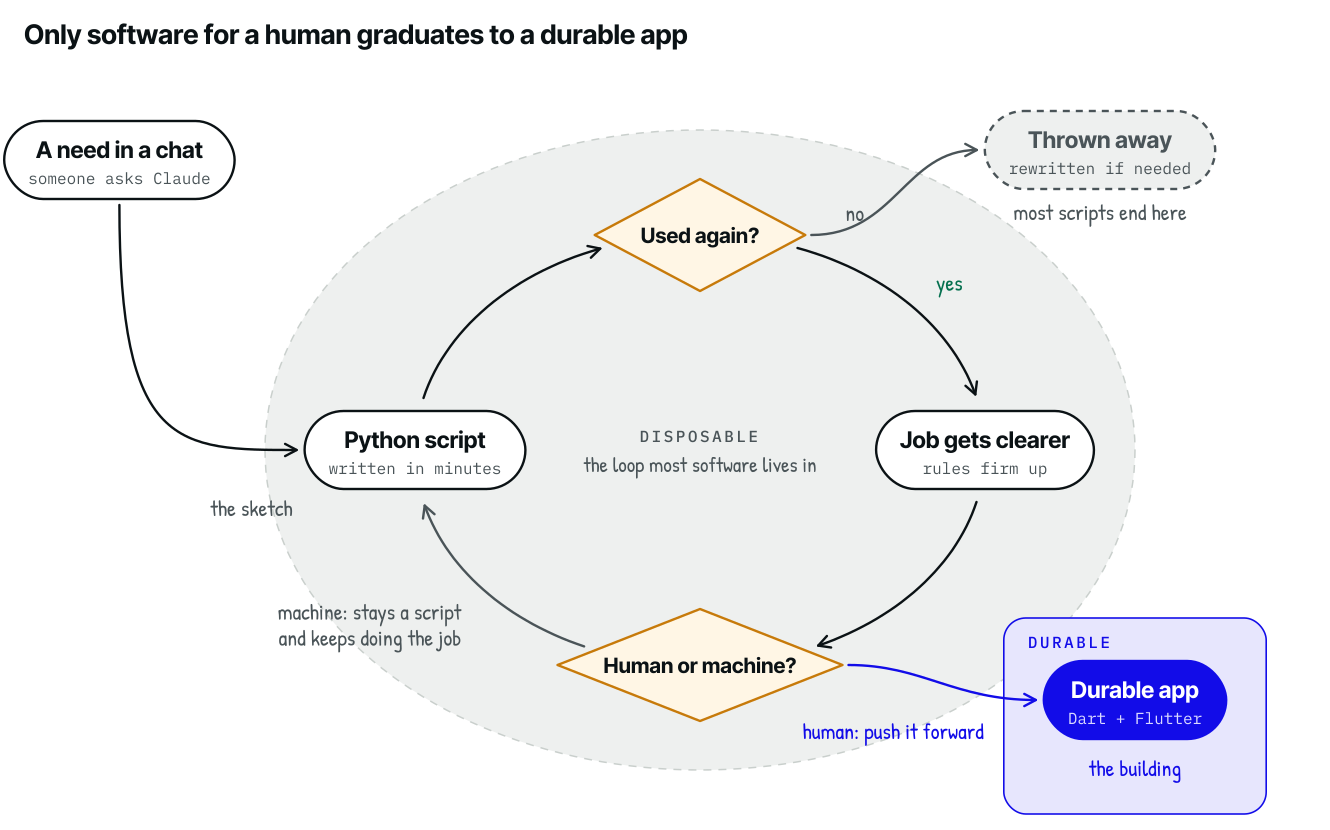
It starts as a Python script run from the command line. Claude writes it during a chat to add a capability on the spot: pull a report, clean a file, check a number. It costs almost nothing, and most of these scripts never live past the week.
Some get used again and again. With each use the job gets clearer: what goes in, what comes out, what can go wrong. Rules that were fuzzy in the first chat become firm. The script stops being an experiment and starts being a process.
Then comes the real question: is this software for a machine or for a human? If only Claude or another program uses it, it stays a script and keeps doing its job. But when a person has to use it, to approve, sign or pay, a command line is no longer enough. It is fine for Claude, but it is no place for a customer. That is the moment to push it forward. The logic that has proven itself moves into a durable product. In my case that means an app built with Dart and Flutter, which runs on both desktop and mobile, where a real customer can enter their details and pay.
Notice what the script did along the way. It earned its keep by doing real work from day one, and it showed us which parts of the job mattered. By the time we build the app, we aren't guessing at requirements. We are writing down what the script already proved.
The script was the sketch. The app is the building.
Where leaders should put their money
- Keep exploration cheap and small. Let teams and AI tools create throwaway software freely, without the approval cycles built for big projects. Give each tool one job, the way good command-line tools do one thing and combine with others. A small tool is easy to understand, so it's quick to tell whether the idea is any good. Judge it by whether the job got done, not by how polished the code is, and don't fund maintenance for something that will matter for a few months.
- Build the human interface to last. Spend on the places people touch: payments, onboarding, data entry, anything customers or staff rely on every day. This is where reliability, security and design pay off.
- Treat the data as the real asset. Disposable code comes and goes, but the data your durable interfaces collect compounds. Own it, keep it clean, and make it easy for the next disposable tool to use.
- Decide the promotion rules in advance. Agree on what moves a tool from disposable to durable: repeated use, a human who needs to use it, money or customer data changing hands.
Guardrails for the disposable layer
Cheap doesn't mean careless. Disposable tools still touch real systems, so a few rules keep the experimenting safe.
- Fence off the data. Throwaway scripts should read from copies or limited views, not write freely to the records your durable systems depend on.
- Keep the request, not the code. When a tool earns a second use, save what was asked and what worked. That record lets the AI rebuild it, and it costs far less to keep than the code.
- Make promotion a real decision. The danger is a throwaway script that quietly becomes critical without anyone noticing. Review what keeps getting reused, then either promote it properly or let it go.
I saw that last one happen long before AI wrote any code. On a supply chain project for TRW, the team reported how much material was in process using an Excel spreadsheet and paper. We wrote a simple Python console program that printed the numbers and updated the Oracle database. It was meant to be a small utility. It ended up as the backbone of the enterprise application.
The tools have changed since then, but the lesson stuck, and it matters more now that a script costs almost nothing to make. A small tool that does one job well gets used, then relied on, then built on. Better to notice that moment and decide on purpose.
The new question
The old question was build or buy. The better question now is throw away or keep. Most of what AI writes for you can be thrown away at almost no cost, and that is a feature. Your advantage lives in the few things you choose to keep: the interfaces your customers trust, and the data they leave behind.
If you're working out where AI fits in your business, book a 30-minute diagnostic.